What it’s for
Trainers like monkeytype measure speed and accuracy, but they don’t know which keyboard you type on. After a move to a split board that isn’t enough: you need to see the imbalance between hands, the slow fingers and what layers cost you. Split Monkey knows the physical layout and the keymap of the keyboard and breaks the stats down along them. The target hardware is a Lily58 running QMK configured through Vial.
The trainer
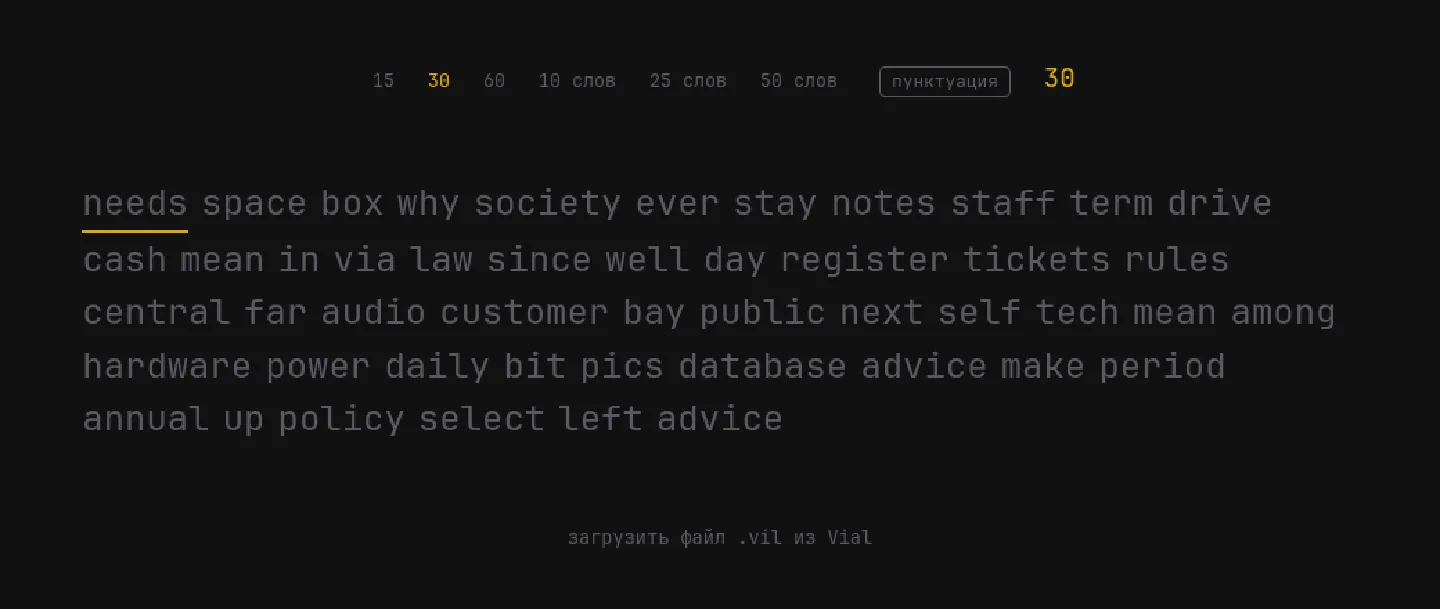
- Modes as in monkeytype: timed (15, 30, 60 seconds) and word count (10, 25, 50), with or without punctuation.
- Speed, accuracy and consistency follow monkeytype’s formulas, so the numbers compare.
- Keyboard under the text. A full Lily58 sits below the words: the key for the next character gets an outline, the pressed one flashes. When a character lives on a layer, both the layer key and the character key light up.
- Layout from Vial. The keymap loads from a
.vilfile. Characters the board can’t produce never appear in the text.
Analytics
- Hand balance and alternation rate.
- SFB: same-finger bigrams and their cost in milliseconds.
- Fingers and keys: presses, errors, median latency.
- Layer cost: how much slower characters on a layer are than the base layer.
- Run history with trend charts and a weak-spot profile over recent runs.
How it measures
The browser sees only what the firmware outputs: layers and mod-taps resolve inside the keyboard. The trainer rebuilds the physical path of each character from the loaded keymap, picks the path with fewer presses and accounts for typing a left-hand capital with the right Shift. The layer breakdown comes from that path; the other metrics come from the keys actually pressed. Latencies aggregate by median, so one pause to think doesn’t skew the picture.
Under the hood
Nuxt, SQLite and an analytics core in its own package. The core takes a stream
of events and doesn’t depend on the DOM, so the input source can move to
WebHID without rewriting the metrics. It deploys with a single
docker compose up. The trainer serves one person: there is no sign-in, and
the port listens on localhost only.